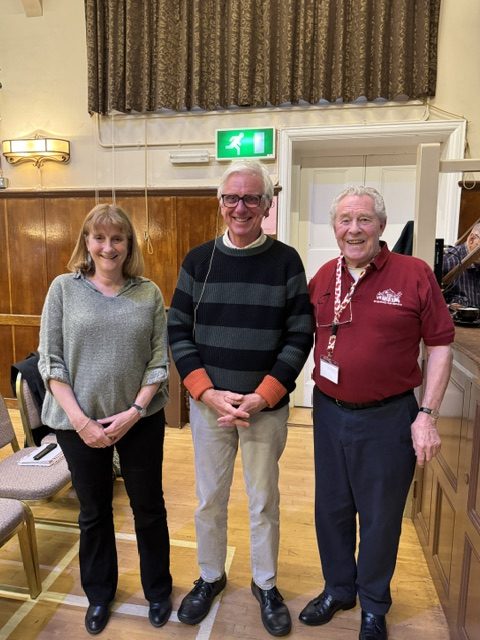
We were delighted to welcome Stephen Anderton to talk to us this month. Stephen is a renowned Sunday Times journalist, broadcaster, photographer and author. Tonight he told us the story of Christopher Lloyd – whose biography he wrote in 2010.
“Christopher Lloyd (Christo) was one of the greatest English gardeners of the twentieth century, perhaps the finest plantsman of them all”. So begins the biography that Christo himself requested Stephen to write, some four weeks before he died. His story is a captivating one, that divides into two very distinct parts – life with his mother Daisy, and life after her death.
Christo’s parents, Nathanial and Daisy, bought the Dixter estate in 1910. They rebuilt and extended the wreck of a house, and started creating the garden that is now famous worldwide. Nathanial planted hedges, Daisy and her six children, of which Christo was the youngest, coloured in the spaces with flowers.
Daisy was an indomitable woman and a formidable mother, with strong opinions that she frequently voiced, about her children, and later their partners. She kept young Christo very close to her, in a way that some would see as stifling, and they ran the garden together until her death in 1972.
That was the point when Christo made a resolution – he would make Great Dixter sing. Freed from the restraints of his mother, he turned the grass in the topiary lawn into meadow, ripped out the rose garden to create an exotic garden, and started using his famously flamboyent colour combinations. His extraordinary attention to detail set him apart from others at that time. He also nurtured young gardeners, launching the careers of the “Dutch Monty” (Romke van de Kaa) and Fergus Garrett, who still runs Great Dixter today.
His legacy, one of England’s finest gardens, is one that most gardeners are familiar with. The story behind the man is less familiar, but endlessly fascinating.