Category Archives: Club Lectures

Graham Gough – Grasses and Late Perennials

Graham’s October lecture gave a different aspect to autumn gardening, with his love of plants when the sun is lowering its arc, which enriches the colours of plants. He likened it to a ‘tarts parade’ of powerful colours that brighten the borders!

He advised dispersing clumps of colour throughout the garden so that it is not all seen in one hit. Groups of colours interspersed with a variety of grasses give a wonderful effect.  Of the many plants he recommended, and the slides were beautiful, his own favourites were Rudbeckias, Asters, Salvias, Limonium, Heuchera autumn bride, Helianthus, Sanguisorba korean snow, Fuchsia hawkeshead white, Persicara pendula, light blue Agapanthus (when in the border, needs to be mulched well to get through the winter) and many more.

He made a plea for not cutting back stems too early as seed heads can be really beautiful in winter especially when frosted, and provide food for the birds. Some of the best heads for late interest and contrast are:- Artichoke, Eupatorium, Veronicastrum, Phlomis, Echinacea and Panicum.  A garden is not just for spring and summer, and an element of autumn flowering should be included in all gardens for maximum interest.

Graham Gough is the owner of Marchants Hardy Plants, Sussex. For a list of Late Flowering Perennials recommended by Graham, click here. More information, as well as a complete catalogue of plants and grasses for sale, is available from the Marchants Hardy Plants website: https://www.marchantshardyplants.co.uk

M.B.

Ray Broughton: Putting plants to bed for the winter

Ray’s credentials – Wisley, 12 years at Sparsholt, teaching for 38 years – are impressive, so when he helpfully listed gardening jobs for the days ahead, all plans for short breaks were cancelled. Joking apart, this (his 250th!) lecture was packed full with tips and advice, as well the latest findings and opinions on new products such as tools and fertilisers. All researched, improved or evaluated in years of practice by Ray (or his students).

The range of jobs, sorry tips, was breath-taking and Ray took us through them at a brisk pace, with slides presenting a helpful illustrative backup, from a gruesome tomato-ketchup soaked sawblade (softwood type preferred), to  Dutch rolls (hardwood propagation) and nutro parcels (feeding hedges),  via a highway for moles crossing an immaculate green and flat lawn (thanks to sulphate of iron).

Ray still managed to find time to answer some questions from the audience before ending his very useful and timely talk to Grayshott Gardeners.

Our Annual General Meeting will be held on the third Wednesday in November (21st) at 8 p.m. in the Village Hall. A printable copy of the Agenda can be found here, and the 2017 Minutes (for approval at the 2018 AGM) are listed under the Committee tab.

Woolbeding Gardens

On Wednesday, Johanna Crawford, Senior Gardener and standing in for Head Gardener Paul Gallivan, entertained us with captivating images of Woolbeding Gardens, situated near Midhurst and presently owned by the  National Trust.

Jo conducting a Herbaceous Borders Maintenance Workshop, photo Emma Haines.

Jo’s gardening career started 8 years ago as a complete novice with a notice in the newsagent’s, an armful of gardening books, a fork and trowel. 8 years of practical experience alongside studying for professional qualifications paid off well, as her passion for heritage gardening at Woolbeding clearly shines through.

Originally mentioned in the Doomsday Book, Woolbeding’s 26 acres of gardens, including the Grade I listed house (privately rented) and Saxon church, are set within the “greenest valley and prettiest river”. The gardens match and enhance the setting, and, following a suggested path, visitors are led through various “rooms” each with their own colour (vegetable, fountain, herb, pool  garden), past follies and intriguing sculptures (in memory of ancient and monumental trees), ornamental  and architectural greenhouses and an orangery fronting the pool. A ”ruined abbey” and a river walk reveal more hidden features.

But the gardens, meticulously maintained in keeping with the original planting but with design tweaks to always offer something new to visitors, are the main attraction and a tribute to the 6 members of garden staff who, aided by a number of volunteers, keep the beds and borders, the climbers and greenhouse plants, including orchids, looking magnificent.

Jo chatting with our patron Gordon Rae

Well-worth a visit (April to September, Thursdays and Fridays only, booking required, 0344 800 1995). More information on https://www.nationaltrust.org.uk/woolbeding-gardens

(Click on photos to enlarge)

Taking a Stand at Hampton Court

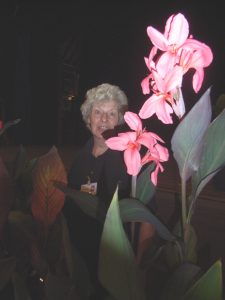
Wednesday’s Club Night Lecture was a true double act: Christine and Keith Hayward co-presented an interesting glimpse behind the scenes at Hampton Court, revealing the pitfalls and triumphs of exhibiting their Cannas in the Floral Marquee. They hold the UK National Collection of Cannas, and have been exhibiting in the Floral Marquee since 2003, winning  Gold (2016), Silver Gilt (2017) and Gold (2018) medals. Along with pictures of the strict security, celebrities and of course their beautifully designed stands, we enjoyed plenty of anecdotes, tips for growing cannas and a fascinating diversion to Argentina, one of the places where Cannas grow in the wild. All this against a background of beautiful flowering cannas of many different colours and shapes, which Christine and Keith had brought along to sell. There were also plenty of leaflets with information on canna plants.

Any members who missed this entertaining lecture are welcome to visit the open day at their location at Wisley during the August bank holiday weekend, where they are holding a trial of many of the 75 varieties of Cannas shown in their catalogue for online sales. More information at   http://www.hartcanna.co.uk/ and  http://www.canna-trial-international.com/

From Seed to Plate: Paolo Arrigo

Red white and green marked the theme of Grayshott Gardeners June Club Night: visitors were greeted with a glass of wine and a sumptuous array of Italian nibbles (topped with flags), and entertained by authentic Italian accordion tunes even before Paolo started his talk proper. As promised, we were disabused of any preconceived ideas: the main seed companies in the uk do not produce seeds, most are imported from South East Asia. Wild fennel, growing along Hadian’s wall, is not native to Britain but was brought here by Roman Soldiers who were partial to the aniseed-flavoured seeds. Via the Boer War, two World Wars and their effect on food growing in the UK, we arrived at the present state of vegetable production and supply in this country, and the conclusion that fruit and vegetables taste best when eaten in season.

Paolo at the Eden Project

This was the cue for a Grand Tour of Italy’s regions, towns even, which are each linked with a particular food or variety of vegetable. Not really surprising, as Italy’s climate varies from the Alps in the North to a Mediterranean climate in the South, and has the Apennine mountains running along its spine. Tips for growing vegetables came hard and fast, and the description of food cooked with them was mouthwatering. The final summing-up was done in one word: local.

Lucky for us, Paolo who was assisted by his mother (as appropriate for the oldest family-run seed company in the world) had brought along a wide selection of Seeds from Italy; Brexit notwithstanding, Grayshott at least won’t be lacking in delicious fresh vegetables from Italy next year.

Catalogue of seeds and other products, as well as further information on Franchi Seeds and their distributors Seeds of Italy available on their website www.seedsofitaly.com

Hydrangeas by Sally Gregson

The May club night speaker was Sally Gregson, owner of Mill Cottage Plants, which specialises in Hydrangeas and Epimediums, mainly from Japan. She brought along a large selection of rare varieties, many of which were snapped up by members.

Sally Gregson

Sally was first introduced to the Japanese varieties by her daughter, who had moved to Japan; she explained how originally Japanese plants arrived in Europe through medical officer Franz von Siebold in the early 19 C. (Japan at that time was a country closed to most foreigners).

We admired the photographs of the many different varieties of hydrangeas, some of which do not even look like hydrangeas;  Sally offered tips for planting, pruning and propagation, and her suggestions for underplanting were particularly useful (hostas, bergenia and others).

A brief question-and-answer session ended this lively and interesting talk.

For more information on hydrangeas and epimediums, visits to the nursery and books written by Sally, see her website https://millcottageplants.co.uk  and also  https://sites.google.com/site/millcottageplants/home

Steve Bradley zooms in on Summer in the Garden

With 22 years of teaching horticulture, and 40+ practical gardening books under his belt, Steve, or ‘Brad’ as he is known,  was never going to serve us up a long and lazy Summer. Instead, he provided us with a wide range of techniques and skills to make the most of summer-flowering plants, as well as fruit and vegetables, by preparing at the right time, and working with the plants, using their inbuilt defence systems and intrinsic growth and/or fruiting promotors.

Steve Bradley, ‘Brad’, at Keukenhof, Holland, 2017

Steve punctuated his talk with anecdotes, some relating to his collaboration with Peter Seabrook, and offered many  tips and techniques, always explaining the why and wherefores. Pelargonium cuttings, for instance, should be taken in Summer, when the plant hormones are active, rather than wait till Autumn.  An avid reader and collector of Victorian gardening books, he revealed that 19th C gardeners used to leave their cuttings briefly in a shady spot in the greenhouse over lunch, as the cut would seal itself and the plantlet’s hormones would flow to the wound and promote root formation – no rooting powder or gel required!

Steve’s eminently practical advice touched on bulbs, seed propagation, pruning, lawn aeration and watering, including getting children to eat fruit, and was illustrated by a series of enjoyable and clear slides. He finished by answering  some questions from the audience, who had turned out in large numbers to hear the gardening correspondent of The Sun. Although too late perhaps for the Spring Show on Saturday 14th April, we may expect even better than usual results for the Summer Show if we follow Brad’s suggestions!

Steve answering questions with his wife Val at the Loseley Show 2017

Sue Biggs, Director-General of the RHS

Sue Biggs

Sue Biggs’ Keynote Lecture on the RHS had been eagerly awaited by Grayshott’s Gardeners, and the packed village hall was not disappointed: Sue managed to convey a wealth of information in the short time at her disposal.

GG members and visitors received a brief yet comprehensive overview of the origins  and development of the RHS from its foundation in 1804, via the granting of a Royal Charter in 1861 by Prince Albert, and since favoured by Royal Patrons, to the present large organisation, followed by slides on the structure of the society while Sue explained the many-varied activities the organisation is involved in, such as training/education, science, shows, bringing together communities, and not least its gardens: Bridgewater, Harlow Carr, Hyde Hall and Wisley. The gardens received more than 2 million visitors during the year 2017/18. Sue then moved on to the future of the RHS, involving an ambitious £160m 10-year investment plan for major improvements to the existing gardens and buildings, in order to deliver much improved benefits to the general public as well as its staff. Funding and most schemes are set for completion within the next few years, with Hyde Hall opening in 2018, and Wisley Welcome opening set for 2019.

Sue also pointed out challenges lying ahead: uncertainty caused by Brexit, funding and membership targets to be achieved, the A3/M25 proposal affecting access to Wisley and a number of scientific threats to vegetation.

Members in the audience made full use of the opportunity to raise topics and issues directly with the Director General; Sue’s explanations and promised action demonstrate her hands-on approach and control of the very wide and varied range of RHS activities.

The evening ended with an appreciative thank you to Sue and the presentation of a cheque donation to the RHS. Further information on RHS activities, events and plans on their website: https://www.rhs.org.uk


Charles Wisden goes Back to Basics

We knew we were in for a fun evening as we watched Charles Wisden fooling around as our dear president was giving her introductory talk.

Charles Wisden

What followed was a fun but very informative talk enjoyed by everyone from novice to the experienced gardener. From seeds to slugs with ideas for design and a look at the latest tools   –  including a rather vicious edge cutting tool with teeth! Potatoes in bags, bulbs in pots, pink primroses, Japanese cucumbers, baby round carrots and how to prune like Phil Mitchell – can’t wait to have a go at that.

In all an inspiring talk on a rather cold wet evening.                  H.D.

(Charles has kindly offered to provide a list of all plants shown, which will be added here later)

Julian Reed, Pteridologist, introduces Ferns

Last night’s club lecture on ferns proved to be something of an eye opener for those members unfamiliar with pteridology, or the study of ferns: rather than uniform in shade and shape, these plants range from minuscule to several feet in circumference, they include tree ferns, and the leaves or fronds can be long, thin, sharp or rounded and with different frills. As a species, they are extremely old, as well as versatile – they are found in almost all countries and in different climate situations.

Julian Reed at his stand the 2017 RHS Hampton Court Show

Their life cycle is as fascinating as it is unusual:  each plant releases millions of spores, almost as a cloud of dust, from their casing at the back of a frond; when they find a suitably damp spot they grow into tiny plantlets, after which male swimmers from one plantlet swim across to reach the female bits of another, fertilisation follows, and a new adult plant grows.

Julian, who joined the Pteriodology Society in 2007 and has since served in various official capacities, is also the current Plant Heritage National Collection Holder of Polypodium Cultivars, and was awarded the Silver Gilt Medal for a stand of Polypodium and Athyrium (most grown in his own garden) in the Plant Heritage Section at the 2017 RHS Hampton Court  Show.

Silver Gilt Medal

Julian was most generous in his advice on propagation (spores, vegetative) and the cultivation of ferns, as well as their protection against frost and general care (including tips on cooking ferns so as not to poison oneself!)

Leaflets from the BPS were freely available for members, and he offered to answer any further questions if submitted via the www.ebps.org.uk website (beautiful and informative). Also, for a few extra tips on fern care, click on this link.

The Grayshott Gardeners plant sale featuring small irises and snowdrops grown by Gordon Rae did brisk business, and was most apposite, as Julian noted that ferns form the perfect backdrop to snowdrops.