Category Archives: Club Lectures

The Gardens at Sissinghurst, by Troy Scott Smith

For our June club night we were expecting to hear from this year’s Sissinghurst Scholar, but sadly he had car troubles that prevented him from making the journey from Kent.  Instead, we were treated to a wonderful talk from Troy Scott Smith, Sissinghurst’s Head Gardener.  He has had a connection with this iconic garden for over 30 years, and his stories about the garden and its history gave us a real insight into this magical place.

Vita Sackville-West and Harold Nicolson bought Sissinghurst in 1930, as an assortment of crumbling buildings surrounded by agricultural land.  Their vision was to create a garden, in a ruin, in a farm.  Over the next 30 years they created the world famous garden that we know today.  They used a formal design, softened by informal planting, and made garden rooms which all had a distinct character and yet all fit together beautifully. 

Both Vita and Harold were writers as well as gardeners.  Sissinghurst was their home, and though they lived unconventional lives they made the house and the garden work for them; sleeping in some buildings, writing in other buildings and dining in others.  This meant that the garden was constantly in use in their daily lives as they walked from room to room.  They were both very much hands on gardeners.  Vita said that her days consisted of writing in the morning, gardening in the afternoon and getting drunk in the evening!

Troy outlined some of the challenges faced by a garden that attracts over 200,000 visitors every year.  As well as keeping things looking good when being trampled by more than 400,000 feet, there is the challenge of managing expectations.  Vita and Harold designed the garden so that different parts peaked at different times – today vistors expect everything to look good always.

Sissinghurst also focuses on growing gardeners – their Scholarship scheme gives young gardeners the chance to work for 18 months with the best in horticulture, setting them up for a great future as gardeners themselves.

The gardens today are managed with a relaxed feel, allowing Vita’s roses, irises and Delphiniums to create the romantic, magical haven that one extraordinary couple envisaged nearly 100 years ago.

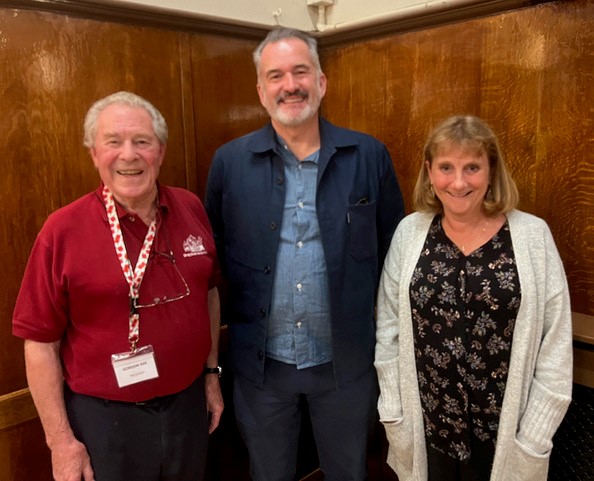
Gordon Rae and Sue Wheeler with Troy Scott Smith

How I grow Dahlias, by Darren Everest

On 14 May, the Grayshott Gardeners had a very entertaining evening with Darren Everest who talked about his passion for growing and showing dahlias. 

Since 2011, with the help and support of his wife, he has been showing large displays of his Dahlias at The Edenbridge and Oxted Agriculture show winning nine consecutive Gold Medals, including Large Gold and the President’s Award for Best Exhibit in the whole show.  He has won at Lullingstone Castle and at RHS Wisley.  In 2021 he was awarded the prestigious ‘personality of the Year’ award by the National Dahlia Society – one of their highest accolades.  He has also appeared on televisions Gardeners World.

October is the end of the season and keeps an eye for the frosts when he lifts and dries the crowns.  The crowns must stay dry through the winter and Darren told us not to store them in newspaper in sheds.  Sheds get damp in the wet winters, and the Dahlias can rot.  He suggested a box with sawdust in a frost-free dry place, a garage or a cupboard in the house.

In January he checks the tubers for any damage or decay and won a hot bed, soak anen he is happy he puts them on a tray with a liberal amount of multi-purpose compost leaving the crowns exposed.  The trays are then placed on a hot bed and watered well.  This encourages new growth and shoots should appear.  Keeping an eye for rotting tubers, after a few more weeks you can take cuttings.  The best cuttings are in early April but do not take the eye on the tuber otherwise the tuber will not shoot again.

When planted out take the tops out so they shoot from the sides and then produce better blooms.  It takes 27 days from bud to bloom.

The pests to look out for are slugs and snails, green and blackfly and earwigs.  The best way to deter earwigs is to rub Vaseline on the stems.  Dahlias need a lot of feeding and water and do well in a border of their own because of this.  Dahlias do most of their growing at night.

Darren ended his talk with photographs of his champion blooms at shows which were very impressive.  He also told us of his book which will be launched at The Chelsea Flower Show next week.

You can get more detailed information from Darren’s website:

darren@darreneverestdahlias.co.uk.

Barnsdale after Geoff, by Nick Hamilton

Nick Hamilton always had a passion for gardening and helped his father Geoff in the garden at weekends and school holidays from an early age.  He studied at Writtle College in Commercial Horticulture and worked for Darby Nursery Stock in Norfolk after completing a year’s sandwich placement there. After working at other various nurseries, in 1989 he went to work with his father at Barnsdale who had just bought a piece of land adjacent to the gardens which formed the nursery.  Nick took on Barnsdale after his father’s untimely death in August 1996.  He has turned the gardens into the wonderfully run, peat free and organic place that visitors can enjoy every day from March to October.  They can also enjoy the various courses run at Barnsdale.

Nick has had appearances on Gardener’s World, has written two books, The Right Genes and The Right Jeans.  He regularly contributes to gardening magazines and gives talks to various groups.  He has won gold medals at Chelsea and has been the president of The Cottage Garden Society since 2007.

On 9 April, The Grayshott Gardeners were treated to a most enjoyable talk and slide show tour of Barnsdale Gardens which was voted Best National Winner of #Best 100 Gardens 2018/19.

The gardens are planned to be like everyone’s gardens and visitors always go home with ideas.  There is a wildlife garden, with an array of birds in a variety of trees and shrubs and frogs in ponds. A Japanese Garden, a Mediterranean Garden with plants that grow well in shingle, a Formal Garden which is beautifully laid with a formal pond with roses and different lavender as low hedging.  There is a Courtyard Garden which is full of plants for all year-round scent and even a Seaside Garden.  He took pleasure in showing us the cordons of apples and pears growing over arches to walk through and the allotment where a variety of vegetables are grown for the café, him and his staff. 

Nick ran a competition for children at local schools to design a garden.  There were 800 designs of which 97% included wildlife and he said it was a very difficult decision to choose a winner. 

The entertaining evening ended with questions and Grayshott Gardeners were invited to buy some of Nick’s plants and books.

Report by Eda Hughes

Managing Legacy, by Tom Brown

Tom Brown with Programme Secretary Sue Wheeler

In March we welcomed Tom Brown, Head Gardener at West Dean Gardens near Chichester, a garden that many of us know and love.  Tom has been Head Gardener there for nearly six years now, taking over the reins from the indomitable duo of Jim Buckland and Sarah Wain when they retired.

Tom’s tenure had only just started when Covid lockdowns began.  During this period West Dean had to be managed by one gardener (instead of the usual eight).  This solitude gave Tom room for reflection.  He decided that the only way he could take the garden forward was to do things HIS way, and whilst he was grateful for and respected the legacy that previous gardeners had left behind, he would not let it daunt him.

Added to this, is the ongoing challenge of managing a garden in a rapidly changing and unpredictable climate.  It is impossible to predict precisely how the weather will change, so Tom believes that diversity in planting is the only way to keep options as open as possible.

Tom took us through some of the exciting changes that he has led at West Dean.  The kitchen gardens are no longer solely for display, but provide ingredients for the College and Visitor Centre kitchens.  A new “dry meadow” has been created on a base of crushed concrete – and is performing very well in the extremes of both drought and floods.  The sunken garden has been reimagined on a base of sharp sand, and the pergola is getting a new border, where plants will all be labelled and named to help the Garden Design students studying at the college.

Tom showed us that there are so many reasons to visit West Dean, for beauty and for inspiration, in every season.  He is certainly making his own very individual mark on these special historic gardens.

What makes a Great Garden? by Annie Guilfoyle

On 12 February, Grayshott Gardeners were treated to a very interesting talk from Annie Guilfoyle on What makes a great garden?

Annie is an award-winning designer and a RHS Chelse Flower Show Silver Medallist.  She runs a garden design consultancy called Creative Landscapes and her design work has been featured on television programmes.  Annie is also a garden course consultant at West Dean College and teaches at Great Dixter House and Gardens in East Sussex.  Apart from lecturing internationally, she is also a regular judge for the Society of Garden Designers and has had articles published in Gardens Illustrated.  As well as supporting many charities, she has an online masterclass with Noel Kingsley.  One Social Enterprise she mentioned was The Greenhouse based in Kent which offers second chances through horticultural training to women based in UK prisons.  Their garden won a Gold at Chelsea in 2024

Annie showed slides of different types of gardens in the UK, America, the Netherlands, and New Zealand, describing how different climates, texture, structures, focus and repetition can be used to in a garden, also explaining how structural planting enhances a garden.  If you incorporate different trees, topiary, clipped hedges as well as shrubs and perennials, (not forgetting bulbs and old-fashioned plants), it will give gardens focus and interest.

She ended the evening by saying:

‘However, it’s your garden, so do your own thing’

Annie Guilfoyle

Text by Eda Hughes

Climbers, by Pip Bensley

On a snowy January evening Grayshott Gardeners welcomed Pip Bensley, who gave us a colourful talk all about climbers, and made us forget about the world outside for a while.

Pip Bensley with Programme Secretary Sue Wheeler

Pip is now a renowned florist, with 3 Chelsea Gold medals to her name, but she started her career in horticulture.  For many years she worked at Hillier, and during her time there she wrote a book all about climbers and wall plants.  It was her wealth of knowledge of these plants that she shared with us during the evening.

Pip talked us through the different types of climbing plants – self clingers, twiners and those that use thorns or prickles to raise themselves up to the sun.  She encouraged us to think about how a plant behaves before we place it in the garden, and to consider appropriate supports that the plant’s characteristics can take advantage of.  

She also reminded us that different varieties of climbers can have differing heights at maturity – and warned us against planting a Kiftsgate rose on a six foot arch, when really it is a plant that needs an acre of garden of its own.

Pip showed us beautiful images of honeysuckles, roses and clematis, and recommended varieties that do well for flower power and vigorous healthy growth.  She gave of lots of ideas for how to bring colour, height and scent to our gardens all year round, but mixed that with a wealth of practical hints that will hopefully make us all better gardeners!

Plant hunting round the world, by Nick Macer

Grayshott Gardeners rounded up its 2024 Programme of Lectures with a fascinating talk from Nick Macer, a specialist nurseryman and owner of Pan Global Plants, a nursery in Gloucestershire.

Nick Macer with Sue Wheeler (GG Programme Secretary)

Nick had what he describes as a “rebellious youth” – at school they said he was “bright but bored”. He dropped out before he was 16, and worked for a landscaping company to earn some money.  He soon learned that a life working outside appealed to him, and trained as an arboriculturalist at Merrist Wood, where he developed a passion (bordering on an obsession) for trees and plants.  In 1997 he persuaded the bank to loan him the money to set up his own nursery, and Pan Global Plants was born.

Nick has been on many, many trips around the temperate world, searching for attractive and unusual plants that will thrive in the UK climate.  In many countries this means seeking out the higher altitudes – and such remote spots bring their own challenges.  We heard of lightning bolts, marauding bears, fording rivers and sleeping in the open – not for the faint hearted.

It was fascinating to see amazing plants growing in their natural habitat, alongside the images of the same plants growing in his own nursery.  Many seeds and bulbils have been collected and nurtured on the nursery until they are ready for sale to eager customers.

By the end of the evening we felt like we had been around the world ourselves – albeit from the comfort of Grayshott Village Hall.  And since most of us are unlikely to be that adventurous, we were very grateful to Nick for sharing his experiences in such an entertaining way.

Winkworth Arboretum: The legacy of a remarkable man, by Peter Herring

This month Grayshott Gardeners welcomed Peter Herring, a self confessed “tree nerd” who has been volunteering at Winkworth Arboretum, near Godalming, for over 30 years.  During this time he has guided many groups around the arboretum, sharing his knowledge of the trees growing there.

The arboretum was the brainchild of Dr Wilfred Fox.  Dr Fox trained as a doctor, and became a renowned dermatologist, as well as using his medical skills on the front line in both World Wars.  Alongside his medical career he was Honorary Secretary of the “Roads Beautifying Association” which was established to plant trees along the new trunk roads that were springing up all over the country in the 1930s and 40s.

However, beautifying roads was just the start of his ambition. He bought land around his country house, Winkworth Farm, and in 1937 started to enhance the planting of trees for autumn colour.  He roped in friends and relations for tree planting parties, and the arboretum started to take shape.  When he retired he pursued his passion for horticulture, and set about planting for other seasons, so there is now always something to see, no matter what time of year.

Now in the hands of the National Trust, Winkworth Arboretum is one of our local gems.  It was lovely to find out how it came to be, and to follow its development over the years.  Our next visits will be richer for knowing the back story to this wonderful place.

Lessons from Great Gardeners, by Matthew Biggs

Photo by Rachel Warne

The September talk for the Grayshott Gardeners was a highly entertaining and informative talk by Matthew Biggs.  Matthew is a radio personality in the UK, best known for his appearances on the long running BBC Radio 4 programme Gardeners’ Question Time. He has been a professional gardener for over 25 years, since studying at Pershore College of Horticulture and the Royal Botanic Gardens, Kew and has written over twenty books. 

The subject of his talk was about some of the great icons featured in his book ‘Lessons from Great Gardeners’.

The gardeners discussed were:

William Robinson, who hated the formal layout of gardens and is famous for his naturalistic style gardens.

Gertrude Jekyll who originally studied at the College of Art and brought art into the garden.

Ellen Wilmott whose very rich godmother gave her money enabling her to indulge her very expensive obsession of her gardens.

Beth Chatto OBE who was a sustainable gardener before her time although her husband Andrew Chatto played a big part behind the scenes in her success.

Roberto Burle Marx, a Brazilian abstract artist who took his art into the garden and played with different shapes and sizes in his designs.

Ganna Walska a Polish American who after marrying 6 times devoted her life to her operatic stage set gardens, selling $1m of her jewellery to finance her gardens.

Matthew was a very amusing speaker and Grayshott Gardeners hope he will visit again soon.

Matthew with our President Gordon Rae

Shrubs: the backbone of your garden, by Geoff Hawkins

On 14 August, Geoff Hawkins gave an interesting lecture on how to enhance your garden with different shrubs and how to care for them.

A man of many talents, Geoff used to manage the 30-acre estate of a private house in Alton, looking after the greenhouses, ponds, shrubs and trees, and now spends his time teaching and giving talks to organisations such as The Grayshott Gardeners. He has also shared his knowledge on radio shows.

His presentation showed the audience how different species of shrubs can be mixed with not only other shrubs but with herbaceous plants and bulbs to give the garden different moods, interest and colour, not only in Spring and Summer but all year.

He talked about the many variegated plants and how when planted together with plain shrubs or flowers can give a garden direction and interest. 

For the rest of the evening, Geoff talked about the different shrubs – giving tips on the best time to plant them and prune them, which ones were the best for flowers in the Spring or Summer and berries in the Winter.

The evening concluded with Geoff answering audience questions.