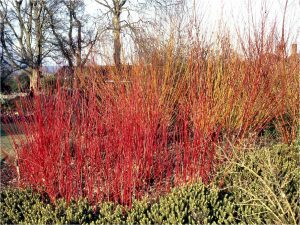
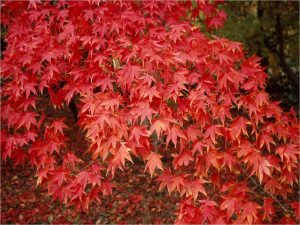
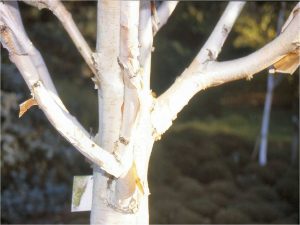
John Negus, with his broad knowledge of gardening subjects, is a man of many talents: writer, broadcaster, lecturer and photographer. At our December Club Night, he demonstrated another string to his bow: quizmaster extraordinaire. Displaying a series of wonderful slides of trees, shrubs, plants and grasses in winter scenes, he urged members of the audience to come up with the (latin!) names of species and even varieties. However, fortified by mulled wine and mince pies, and occasionally helped by John Negus’ mindreading skills (“Were you thinking of …”) our members rose magnificently to the occasion and together we put on a great show.
Bark
Autumn
Ghost Tree
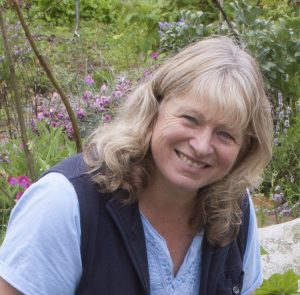
John Negus with member Jan Bebbington
(click image to enlarge)
The evening concluded with a couple of questions from the audience answered by John Negus, followed by the results of the raffle, with mystery prizes neatly wrapped up as Christmas parcels, in keeping with the theme for the evening.
Our October lecture featured Keynote Speaker Anne Swithinbank, horticulturist, writer and broadcaster. Keen gardeners will know her from Radio 4’s Gardener Question time, on which Anne has been a regular panelist for 23 years, and for which she travels the length and breadth of the UK.
Anne’s chatty style came over well in the packed Village Hall. She explained the various reasons why she has favourite plants: a) emotional, e.g. inherited plants (how James Wong and his planted furniture came into this is hard to remember, but I cannot get the picture Anne painted of his flat out of my head); b) they do a specific job; c) they taste good; d) fragrance and e) for a laugh, e.g. slut mix (sic) plant, used as a cure for a mare’s ailment!
In addition to a collection of real plants (both Anne’s and her husband John’s favourites), we enjoyed a series of beautiful slides featuring named plants flowering throughout the year, while Anne explained their particular characteristics. The talk was concluded by Anne answering questions from the audience. An evening well worthy of the term Keynote.
We enjoyed a very informative evening with John Wood, Head Gardener at Hinton Ampner, who, having restored the rose garden at Mottisfont, arrived to do more of the same at Hinton Ampner.
‘Constance Spry’ (photo John Wood)
We looked at glorious pictures of dew-soaked blooms in all colours with not a greenfly in sight. There were rampant ramblers, clinging climbers, old species roses that produced glorious hips and ideas of what to plant underneath roses. It is far more interesting to see lavender or dianthus rather than bare soil.
John gave us a fascinating history of rose cultivation. For instance, did you know there is fossil evidence that roses evolved over 35 to 40 million years ago? Me neither. More recently, roses were being cultivated in China in 3,000 BC. It was not until 1897 that hybrid tea roses were first introduced with the characteristic large, scrolled flower on a single stem, floribunda roses coming shortly after in Germany in 1907.
‘Iceberg’ over a wall at Hinton Ampner (Photo John Wood)
Most roses these days are grafted onto the strong root stock of Rosa Laxa, We all have experience of annoying and frustrating rose diseases. The most basic one we come across is Specific Rose Replant Disorder caused by replanting new roses in old rose ground. The flowers go brown due to the roots not flourishing. This can be prevented by applying mycorrhizal root grow which is a friendly fungus and extends the root growth to allow more absorption of water and nutrients.
We learnt where we might have been going wrong with our pruning techniques and that we should not be afraid of cutting old and damaged shoots right down to the ground provided that a few taller healthy shoots are left to give a good shape. Be bold, we were told, the harder you prune the larger the flowers. January to March is the ideal time to do this. Suckers should be shown no mercy and should be ripped out from where they grow often below soil level. When buying new roses it is better to buy bare rooted plants, heeling them in well and ensuring that the graft joint is covered by soil.
‘Scharlachglut’ (photo John Wood)
We should not despair that we cannot grow roses in our acid, sandy soil. Just keep piling on the compost and talk nicely to them. They also respond to organic pellets and a spray of liquid seaweed once a month from Spring onwards.
One last factoid for all those of a certain age, the Peace rose with its yellow flowers flushed pink and enchanting fragrance was introduced in 1945 after the 2nd World War. It was one of my Dad’s favourites.
On Wednesday we were pleased to welcome David Jewell, Head of collections at Sir Harold Hillier gardens, and formerly Floral Superintendent at RHS Wisley.
David explained the main style elements for plant association: height, vertical lines or accents, outline and shape, foliage colour used as a foil and flower shapes, as implemented in the classic Mixed Border at Wisley. He contrasted this with the more naturalistic and modern Glasshouse Borders designed by Piet Oudolf, which require much less staking, feeding and irrigation. Slides of a Prairie Meadow Garden completed the trio of very different styles of gardens, leaving the audience with much to mull over.
Wednesday’s Keynote lecture by Tom Hart Dyke turned out to be two treats in one: an adventure story and a botanical trip round the world, illustrated with amazing slides and told with a good deal of verve and humour.
Tom Hart Dyke, Award Winning Plant Expert. Writer, Author, Television Presenter, Adventurer
It all started at Lullingstone Castle in Kent, where his granny encouraged Tom to collect plants, in particular orchids, and nearly ended 17 years ago Colombia, when he and his friend Paul Winder were kidnapped by a band of teenage guerrillas and held for 9 months, constantly fearing for their lives, while travelling between temporary camps in the jungle. The idea of a World Garden in the shape of a map, and stocked with indigenous plants, was born there and sparked off decades of hard work and extensive travel to source appropriate plants and help with their preservation.
We were shown some of the wondrous plant shapes and colours, small and gigantic, photographed by Tom on his trips to various continents, and especially South America (he did go back to Colombia!) . For those wanting more, Tom’s collection of more than 6000 different plants, including The World Garden, is open for visits at his family seat of Lullingstone Castle near Sevenoaks in Kent (see www.tomhartdyke.co.uk for details).
For our May lecture we welcomed Rosamund Wallinger, owner of Upton Grey and restorer of the ‘lost’ Gertrude Jekyll Garden.
We heard how the discovery of a full set of plans resulted in what is believed to be the most complete and authentic Jekyll garden in existence, after years of research, traveling far and wide to track down original species of plants and decades of hard work. Rosamund told us about Gertrude Jekyll’s life, the people whom she befriended and influenced, and her philosophy of garden design. The accompanying slides beautifully illustrated the different components of the garden; how Jekyll cleverly softened the formal dry stone walls with drifts of plants and flowers; and the transition to the more natural Wild garden, including the pond. More information about visiting Upton Grey and the books written by Rosamund Wallinger can be found on her website: www.gertrudejekyllgarden.co.uk
We welcomed John Baker (Hanging Hostas) and partner June Colley at our February Club Night for an interesting and informative talk on the Perfume of Plants. Members were told about the different kinds of scent, that these are produced by various parts of plants, not just the flowers, and that a perfumed garden can be enjoyed throughout the seasons. John even provided a recipe for home-made perfume, involving vodka.
John admitted that the information for his talk was provided by June, a professional where perfumes are concerned, and we were all delighted to be invited to sample the various fragrances in phials which she had been busy arranging in the side room.
There were over 100 members and visitors for Gordon’s excellent talk on Galanthus, or Snowdrops to the majority of us!
Autumn Snowdrop G. reginae-olgae (photo Gordon Rae)
Through some beautiful photography he demonstrated the subtle differences in appearance, size and cultivation of some of the many known species. With over 1500 named varieties and cultivars spanning from Spain to Russia, it is possible to have snowdrops in bloom here from October through to late March. Rare bulbs can command many hundreds of pounds.
Gordon and Judith will be opening their lovely ‘snowdrop extravaganza’ garden to GG members, friends and villagers on Saturday 11th February between 10 – 12pm. A rare opportunity to discuss and see so many varieties in-situ, and perhaps purchase one or two for your own garden.